How to upzone:
Take action: Tell city council you support further upzoning. Write, email, or call (leave a message). While you probably won’t hear back, they are listening! Whether you do it for yourself, to help others, or for justice, voicing support for upzoning will make a difference.
Write a letter to our city council representative, Dan Strauss (Dan.Strauss@seattle.gov), telling him that you support upzoning Frelard. Consider mentioning the following:
- Who are you?
- Do you live or work in Fremont, Ballard, or Frelard?
- What future do you hope for living in Frelard?
- Do you support upzoning (density and mixed-use) in Frelard and why?
Leave a short voice message. Call 206-684-8806 and say this: Hi Dan! My name is ____________. My number is ____________. Frelard is where I live/work. Please upzone Frelard because….
- I want my property value to increase.
- I want more flexibility around developing my property.
- I want Frelard’s walkability to improve.
- Rent inflation is out of control.
- It’s a real long-term solution to curb homelessness.
- Developers should have more competition to build quality apartments.
- Zoning was a racist policy.
- For sustainability reasons.
Doing nothing means yellow areas (and some of the gray industrial areas) on this map continues to restrict density that could curb homelessness (One Seattle Plan)

Policy is never immutable. Seattle is moving into phase two of its comprehensive plan. The decisions made now will bias Frelard’s trajectory for the next 20 years (Seattle City Council Blog). Frelard may have lost its easy chance to become a neighborhood center in phase one, but a lot can still be fought for in phase two. So long as we try, we can earn back greater freedoms, such as building a shop, permitting residents in industrial areas, or more apartments on the same lot. Update: As of Jan 2026, operating a shop in residential neighborhoods is legal again (Seattle opens residential areas to small cafes, corner markets, Axios). Further upzoning directly contributes to the long-term value, walkability, and economic vitality of our neighborhood.

NW 39th St, near Evanston Ave N. Pictured is an apartment building constructed in 1967 neighboring a single family home built in 1929. Upzoning does not force change, it simply allows for it to happen. You’ll be (re)gaining the freedom to choose how and when to develop your property.
What to expect? Gradual progress. The goal of upzoning Frelard is to permit diverse growth for its many benefits. With nothing changed, for example, by 2050 commutes would be 17% slower and rents 21% higher than in 2024 (How does upzoning impact land use and transport: a case study of Seattle, Transportation Planning & Technology). June 2025, Seattle upzoned a little (The new Seattle housing laws that make it easier to live near friends, Live new friends), yet it’s not enough (Seattle’s revised housing plan is still too restrictive, Pacific Research Institute) (Seattle just rezoned entire city – That was the easy part, Urbanist). Timid change may moderate our current trajectory, yet it will not halt it, and it certainly won’t reverse it. Further upzoning is needed so more residents can be house than those in tiny homes in our industrial zones (New tiny house village opens in Ballard on NW Leary way, My Ballard), for example. Further upzoning could help you, or your children take an entrepreneurial step (Loosen up: How mixed-use zoning laws make communities strong, Strong towns). Such progress happens over the course of decades, so if you want a better future Frelard, act prudently now!
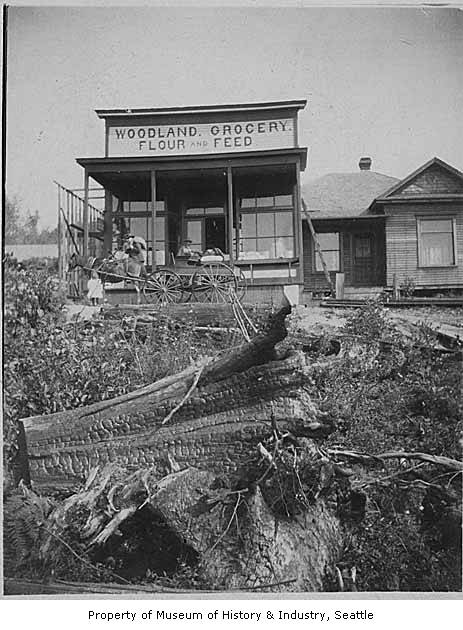
Around 1905, 60th & 4th Ave NW was the location of one of the earliest shops in the area (MOHI via U Washington) (Vintage West Woodland). Today it is a single family’s home, and a shop would be illegal by modern zoning laws—unless people demand the freedom they lost back.
 Upzone Frelard